
How FP&A Supports the Procurement Cycle
How FP&A Supports the Procurement Cycle
When Procurement and Finance work in silos, value leaks.
Procurement negotiates savings, but Finance doesn’t always see them land on the P&L.
Finance builds cost targets, but lacks visibility into what's actually happening with vendors, contracts, and deliveries.
But when FP&A and Procurement work together—aligned across each stage of the procurement cycle—the impact is measurable. Better timing. Smarter sourcing. Fewer surprises. Stronger margins.
In this article, we’ll walk through the procurement cycle from start to finish, highlight where FP&A can step in to add value, and show how to break down spend variances using Price-Volume-Mix (PVM) analysis. You’ll also find a downloadable Excel template and links to two video tutorials for hands-on learning.
Understanding
How FP&A Supports the Procurement Cycle
Understanding the Procurement Cycle
6. Review & Manage Supplier Performance
PVM Analysis: A Tool for Real Insight
Download the Free PVM Excel Template
Common Procurement KPIs to Track (With Finance Input)
Conclusion: From Cost Control to Strategic Enablement
the Procurement Cycle
Below is a visual representation of the procurement cycle and FP&A’s involvement at each stage. This framework helps define not only what Procurement owns, but also where Finance can meaningfully contribute.

Throughout the article, we’ll reference cropped sections of this diagram to focus on individual stages.
Watch the video:
1. Identify Need
Finance plays a critical role from the moment a need is defined. At this point, FP&A helps validate:
Budget availability
Business case justification
ROI modeling (e.g. make vs buy decisions)
At this stage, a small change in timing can often yield significant cost advantages. For example, deferring a hardware order by six weeks based on forecasted price drops may save hundreds of thousands of dollars.
Key considerations for FP&A:
Is this need already included in the plan?
Is it capitalized or expensed?
Can it be timed differently for budget or cash flow optimization?
2. Source Suppliers
As Procurement begins evaluating suppliers, FP&A provides insight into:
Total cost of ownership (TCO)
Financial health of vendors
Long-term cost vs value trade-offs
Risk exposure related to currency, inflation, or supplier stability
Finance KPIs at this stage:
Cost per unit
Supplier risk rating
Vendor cost comparison
Supplier financial viability (liquidity, credit risk, etc.)
3. Negotiate & Contract
This is where Finance should be deeply involved, yet often isn’t.
Contracts are financial instruments. FP&A can model the implications of:
Volume-based pricing tiers
Escalation clauses
Payment term scenarios (e.g. 30 vs. 45 days)
FX or inflation-linked adjustments
One example: A contract offers a $2.00/unit price if the company purchases over 1,000 units—but jumps to $2.20 if the minimum isn’t met. Without modeling this scenario, Procurement may commit to the lower volume and inadvertently drive up total cost.
We walk through how to model and mitigate this kind of risk in this video:
4. Order & Purchase
Once orders begin, Finance ensures spend is:
Tracked against forecast
Compliant with budgets and cost centers
Monitored for early exceptions
PO-level tracking helps identify issues before they escalate. In some cases, a PO may come in 30% over forecast—not because of price inflation, but due to product mix changes or misalignment with contract terms.
This is where PVM analysis becomes an essential tool.
5. Receive & Pay
Finance owns working capital strategy, and payment timing plays a major role. FP&A can advise on:
Payment term optimization
Early-payment discount ROI
Cash flow smoothing across suppliers
This is especially important during periods of tight liquidity or end-of-quarter working capital optimization.
Key metric to monitor:
DPO (Days Payable Outstanding)
6. Review & Manage Supplier Performance
Procurement owns supplier scorecards, but FP&A ties performance back to value delivery.
Did negotiated savings actually show up in the P&L?
Were penalty clauses triggered?
Did delays result in operational costs?
Finance ensures performance reviews are backed by real cost and savings data—not just SLA compliance.
PVM Analysis: A Tool for Real Insight
When a PO is over budget, the natural reaction is to ask, “Did the supplier raise prices?”
But sometimes, prices didn’t change. The mix of products did. Or perhaps the same volume was purchased at a higher rate due to missing a contract tier.
That’s where Price-Volume-Mix (PVM) analysis helps break down what really happened.
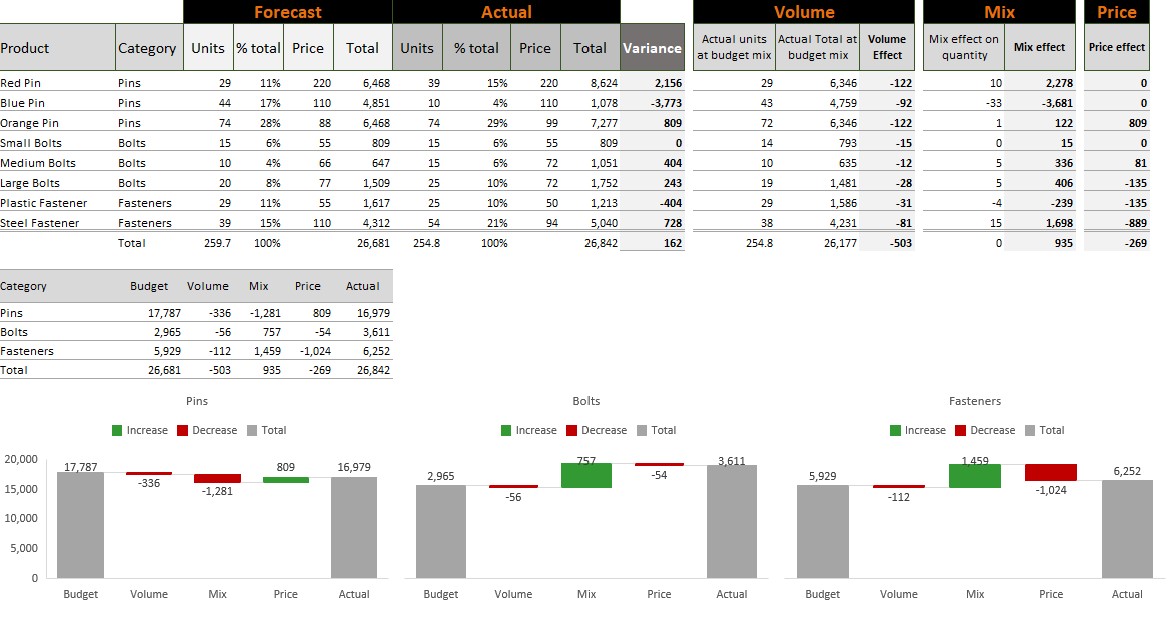
We built the analysis below to dissect spend across three categories—Pins, Bolts, and Fasteners—each with multiple interchangeable products.
(Insert screenshot of PVM Excel worksheet — summary table + charts)
This analysis separates total variance into:
Volume effect – Did we buy more or fewer units than planned?
Mix effect – Did we buy more of the expensive items and less of the cheap ones?
Price effect – Did the supplier change their price, or did we lose a pricing tier?
We show how to perform this step by step in the video below:
Download the Free PVM Excel Template
Use our PVM Excel template to analyze your own procurement data. It works across multiple product categories and includes built-in variance formulas.
Common Procurement KPIs to Track (With Finance Input)
KPIPurposeForecast vs Actual SpendIdentify overages earlyCost per Unit (by item)Track purchasing efficiencyDPO (Days Payable Outstanding)Manage working capitalSupplier Risk ScoreFlag financially unstable vendorsSLA AdherenceEvaluate supplier performanceRealized Savings %Validate Procurement’s contributionInnovation ROITie strategic sourcing to business impact
Conclusion: From Cost Control to Strategic Enablement
FP&A’s role in procurement goes far beyond cost policing. It’s about strategic enablement, risk mitigation, and long-term value creation.
With the right involvement, Finance helps Procurement:
Make smarter sourcing decisions
Prevent risk exposure before contracts are signed
Maximize working capital impact
And explain why things go off track—not just that they did
Bringing PVM analysis into the process ensures every variance has a story—and every decision has data behind it.
